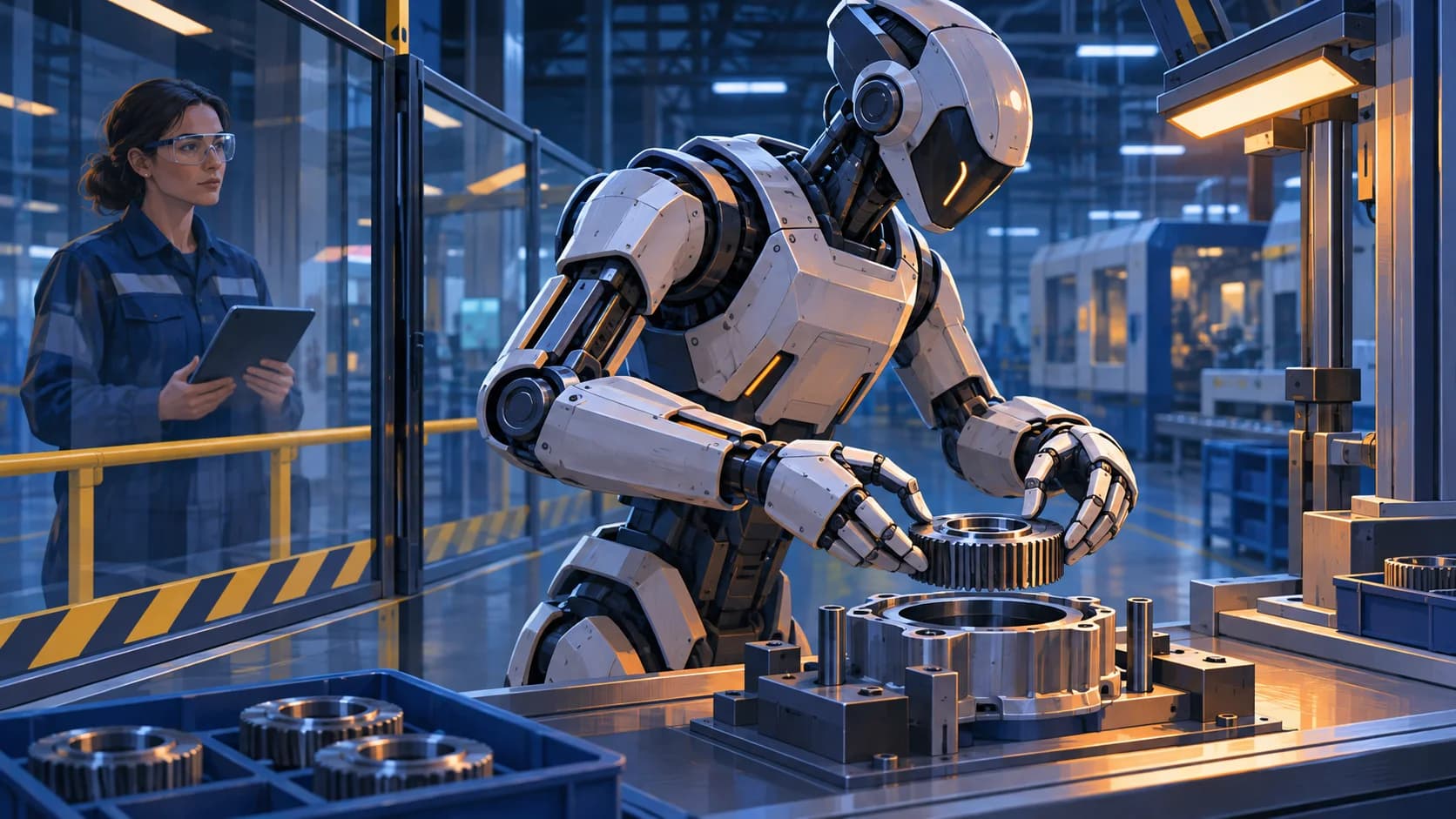
Humanoid robots have moved beyond demonstrations in selected industrial settings. Reliable, economical everyday work remains a much harder test.
The new race to build human-like robots
A robot that walks into a factory and picks up a component makes a compelling demonstration. The more difficult question begins after the camera stops: can it repeat the task safely, recover from mistakes and justify its cost through an ordinary working week?
That gap between a visible achievement and a dependable service defines the humanoid robotics industry. Real industrial projects now provide evidence beyond laboratory demonstrations. Yet evidence of one useful task is not evidence that a machine can take on any job designed for a person.
The answer to how close we are depends on the environment. A carefully arranged work area with a narrow task is a different proposition from a crowded home or an unfamiliar construction site. Understanding that distinction makes the technology more interesting, not less: it reveals where progress can become useful before general-purpose robots arrive.
What makes a robot humanoid?
A humanoid borrows elements of human body form, commonly a torso, arms and legs. Not every machine in this category duplicates human anatomy, and appearance says little by itself about intelligence, autonomy or practical capability.
The attraction is compatibility with spaces and equipment already designed around people. The International Federation of Robotics' 2025 assessment identifies that opportunity while emphasising uncertainty about mass adoption and the continuing role of other robot types.
A human-like shape is therefore a design hypothesis, not proof of efficiency. If a wheeled platform can do a job more reliably, legs may add unnecessary complexity. If a fixed arm can repeatedly reach every required location, walking between stations may offer little value. The right comparison is the best practical alternative for the task, including changes to the workplace itself.
How AI improves robotic capabilities
A useful robot must connect perception with action: identify an object, interpret an instruction and choose a movement that advances the task. Recent research investigates whether models trained on visual and language data can help make those connections more flexible.
The 2023 RT-2 research paper describes a vision-language-action approach linking broader visual and language learning to robotic control. The 2024 OpenVLA paper examines an accessible model and adaptation to manipulation tasks. These are research contributions, not evidence that any humanoid can safely perform arbitrary work.
The distinction between recognising an instruction and executing it is essential. A model might associate a cup with drinking yet still fail to grasp a wet, transparent cup on a cluttered surface. Physical success depends on sensing, geometry, contact and control, not merely a plausible description of what should happen.
AI can expand the range of situations a robot handles, but the commercial test is how reliably it does so within a defined operating environment. A system that recognises its own uncertainty and requests help may be more useful than one that appears confident while making dangerous mistakes.
Sensors, actuators, mobility and manipulation
Cameras provide visual information; other sensors can help measure motion, contact or forces. Actuators turn control signals into movement. The control system must coordinate those components while accounting for the fact that the world does not remain still between observation and action.
Consider lifting a partly filled container. Its appearance may not reveal its weight, and the contents can shift during movement. The machine needs a workable grasp, enough force to hold the object and a response when the object moves unexpectedly. The surrounding station must also tolerate the consequences of a failed attempt.
Walking introduces additional dependencies. A robot carrying something changes its balance, while damaged flooring or an obstructed route changes the demands on navigation. Hands and legs cannot be treated as independent features whose capabilities simply add together.
This is why a specification sheet should be read as a starting point. Reach, payload or battery figures mean little without knowing the conditions under which they were measured and how they interact during the actual task. This article does not use advertised prices or performance figures as verified operating economics.
Companies developing humanoid robots
Three documented examples illustrate different commercial approaches. Agility Robotics develops Digit, associated with logistics handling. Figure works on humanoid applications including manufacturing and logistics. Boston Dynamics presents Atlas as an industrial humanoid platform in its official product documentation.
These examples are not a ranking of the market. Product materials describe the manufacturer's intended use and reported capabilities; they do not establish independent comparative performance. A buyer needs evidence from the specific application, including failure rates, intervention requirements and support arrangements.
The most informative question is often what the developer has chosen to constrain. Restricting an object type, work area or operating speed can make a system more dependable. That restriction may be a sensible route to commercial value rather than evidence that the whole project has failed.
Current industrial applications: what is documented?
In June 2024, GXO announced a multi-year agreement with Agility Robotics following an earlier pilot. The announcement described Digit deployment in logistics under a robots-as-a-service arrangement. This is customer-side evidence of a commercial agreement, although the release is still a company account rather than an independent operational audit.
BMW's June 2026 update described experience with Figure 02 and a Figure 03 project focused on logistics sequencing at Spartanburg. The release discusses development and deployment in a defined production setting. It should not be read as proof that humanoids have become general replacements for manufacturing workers.
Those examples establish that the industry has moved beyond demonstrations alone. They do not establish industry-wide profitability, universal safety or a particular scale of adoption. Public announcements rarely supply every input needed to independently calculate the cost of a successfully completed task.
Why warehouses and factories are early targets
Industrial environments can offer a valuable compromise: they contain work worth automating while allowing operators to control important parts of the setting. Containers can be standardised, routes marked and the robot's responsibilities defined more narrowly than they could be in a typical household.
That does not make a warehouse simple. People, vehicles and irregular objects still create variation. However, an operator can choose a limited starting task and decide whether the resulting system improves the larger process.
Imagine a robot transferring containers between two stations. Its value depends on whether the downstream station receives the right item at the right time. A fast transfer that frequently requires someone to correct placement may be less useful than a slower but predictable process. Evaluating the entire workflow prevents a visually impressive component from hiding an operational bottleneck.
A successful deployment might also require modifications around the robot. The correct economic comparison includes those changes rather than pretending that human-shaped hardware can always enter a human workplace without adaptation.
The economics: cost per successful task
A purchase price is only one part of the bill. Integration, supervision, maintenance, replacement parts, electricity, training and downtime all affect operating cost. A service contract may shift who pays particular expenses, but it does not make those expenses disappear.
A useful assessment starts with successful output over a meaningful period. How many tasks were completed without intervention? How much human attention was required? What happened during charging, maintenance or a software update? Were failures merely inconvenient, or did they interrupt a production line?
A practical evaluation framework
Compare the proposed robot with the current process and at least one alternative form of automation. Keep the task, quality standard and operating hours consistent. Include the work done by people who reset the robot, prepare its environment or resolve unusual cases.
Then test a less favourable scenario. If demand falls, if an operator must supervise more often than expected, or if spare parts take longer to arrive, does the project still make sense? These are analytical questions, not claims that any named supplier has failed them.
The most promising early application may be one where the robot's modest flexibility solves an expensive inconvenience. It need not resemble a complete human job to create value.
Technical challenges and safety
Working near people changes the consequences of an error. A mistaken software response can be corrected on a screen; an unexpected physical movement can affect a person or damage equipment. Safety therefore belongs in the design of the entire operation, including the work area and the actions people take when something goes wrong.
This article does not certify any product or prescribe a safety standard. Site-specific deployment requires appropriate professional assessment. For readers evaluating announcements, the important questions concern operating boundaries, emergency stopping, unexpected contact, remote access and responsibility for failures.
Reliability also includes recovery. Can the system recognise that an object has fallen? Can it stop without creating another hazard? Does it explain its state clearly enough for an operator to respond? A robot's behaviour during failure may matter more than the elegance of its best successful demonstration.
People need understandable procedures and authority to interrupt the system. Calling a machine collaborative does not establish that every configuration is safe to use beside a person.
Demonstrations, pilots and commercial deployments
These labels answer different questions. A demonstration shows that something happened under selected conditions. A pilot tests a proposed application in a limited setting. A commercial deployment involves an operational business arrangement, but may still cover a narrow task or a small number of machines.
A video alone rarely reveals how many attempts were made, whether a person intervened, how the task was prepared or whether footage was accelerated. The useful response is to ask for that context, not automatically dismiss the result or accept the strongest interpretation.
What stronger evidence looks like
Look for a clear task definition, a named operating environment, the measurement period and disclosure of human support. Customer confirmation is helpful, but independent evaluation would add confidence. Evidence becomes stronger when results remain consistent across ordinary variation rather than only one prepared sequence.
The same discipline applies to timelines. A company's target date expresses an intention. It becomes evidence of delivery only when the relevant deployment has occurred and its scope is clear.
The future of human–robot collaboration
A plausible near-term path is selective collaboration: machines take on bounded physical tasks while people handle exceptions, planning, maintenance and work requiring broader judgement. This is a scenario, not a promise that employment effects will be uniformly positive.
How responsibilities are allocated matters. If workers merely inherit constant interruptions and monitoring duties, an apparently automated process may create a different kind of strain. If they help design the workflow and receive useful training, the same technology may support better work.
The social outcome will depend on business choices as well as technical capability. Productivity gains do not automatically determine wages, staffing or working conditions. Those decisions should remain visible in a discussion that can otherwise become absorbed by the machine itself.
Key findings and conclusion
Humanoid form may help with human-designed environments, but other robot designs remain important alternatives.
AI research expands possibilities without proving universal physical competence.
Customer announcements document specific industrial projects, not general adoption or independently verified profitability.
Cost, recovery from failure and the working conditions of nearby people are central to commercial usefulness.
Robots are already being tested and deployed alongside people in defined settings. The next meaningful milestone is not simply a more human-looking machine. It is repeatable evidence that a particular robot improves a particular workplace over time, including the ordinary days when something unexpected happens.